ALONG THE BACK ROADS . . . .
Visiting the People and Places of Honey Hill Country with Henry Calder

“A Little Sweetness, a Good Deal of Work”
Henry Calder has always believed that every town, shop, farm, and front porch has a story worth telling. Along the back roads of Honey Hill Country, he spends his days meeting neighbors, sharing conversations, and discovering the people and places that make the countryside feel like home.
By Henry Calder
The first thing I noticed at Watson Farm was that somebody had given the mule a hat.
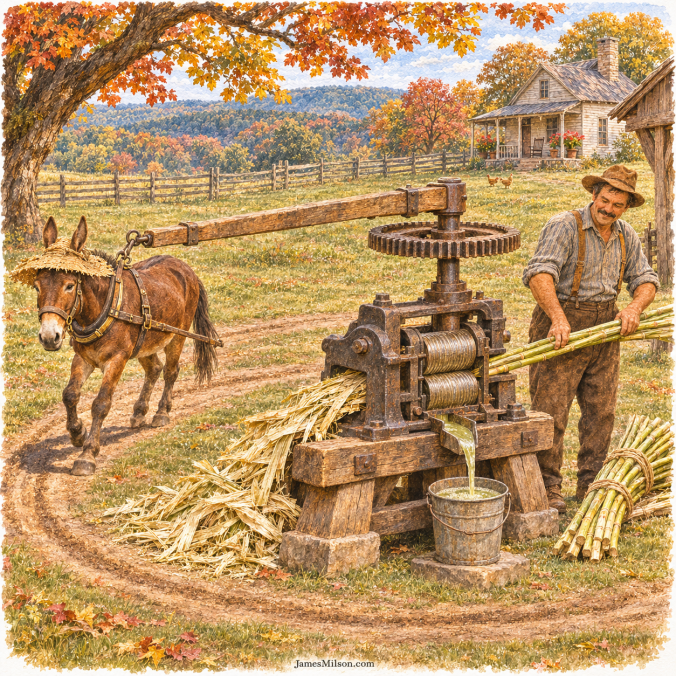
It was a straw hat, somewhat the worse for acquaintance with its owner, with two openings through which his ears stood comfortably upright. Beneath it, Chester walked a broad circle around the cane mill with the steady manner of a fellow who understood his responsibilities and saw no advantage in discussing them.
I had come out from Butterfield earlier this Autumn to see how Emery and Nettie Watson made their Sweet Sorghum Syrup. By November, a jar of it looks quite at home beside the biscuit plate. I wanted to see what happened before it reached the table.
Chester, apparently, intended to show me.
“Children thought he needed a hat,” Emery said, following my glance.
“Does he mind wearing it?”
“Only when somebody borrows it.”
The morning was cool enough for a coat in the shade. Near the outdoor furnace, however, I soon unbuttoned mine. Wood smoke drifted across the yard, and steam rose from a long, shallow pan above the fire. Beneath those familiar smells was another — green and sweet near the mill, richer and warmer nearer the boiling juice.
Bundles of harvested Sorghum Cane lay ready beside Emery. The leaves had been stripped away and the seed heads removed, leaving long stalks that looked unpromising material for anything I would want on a biscuit.
Emery selected a few and guided their ends between the iron rollers.
The mill took hold.
As Chester walked, the long wooden sweep turned the gearing, and the rollers drew the stalks through with a creaking, crushing rumble. Juice ran into a collecting vessel below. The stalks emerged on the opposite side flattened and frayed, having surrendered a surprising amount of themselves.
I moved a little closer.
“Best view’s from this side,” Emery said, directing me clear of the sweep and the working parts.
From there, I could follow the whole arrangement. Chester supplied the steady pull, the sweep turned the mill, and the rollers squeezed the cane. Emery fed it carefully, keeping his hands well back.
Nothing about his movements was hurried.
“Do you have to persuade him to keep going?” I asked.
“Chester? No. Have to persuade him we’re finished sometimes.”
One long ear turned in our direction. The rest of Chester continued with the work.
The fresh juice was thin and pale, with a greenish cast. Had I encountered it without explanation, I would never have guessed its destination.
“That becomes the syrup?”
“Given a fire and some attention.”
Nettie approached carrying a clean vessel.
“And somebody to keep giving it attention,” she added. “It won’t improve itself while you go off after something else.”
She strained the collected juice before it went to the cooking pan. Nearby, clean containers stood ready for the finished syrup. There was an order to the place that became clearer the longer I watched: cane waiting for the mill, juice moving toward the furnace, finished syrup cooling and being put away.
The family knew where everything belonged. I chiefly distinguished myself by learning where not to stand.
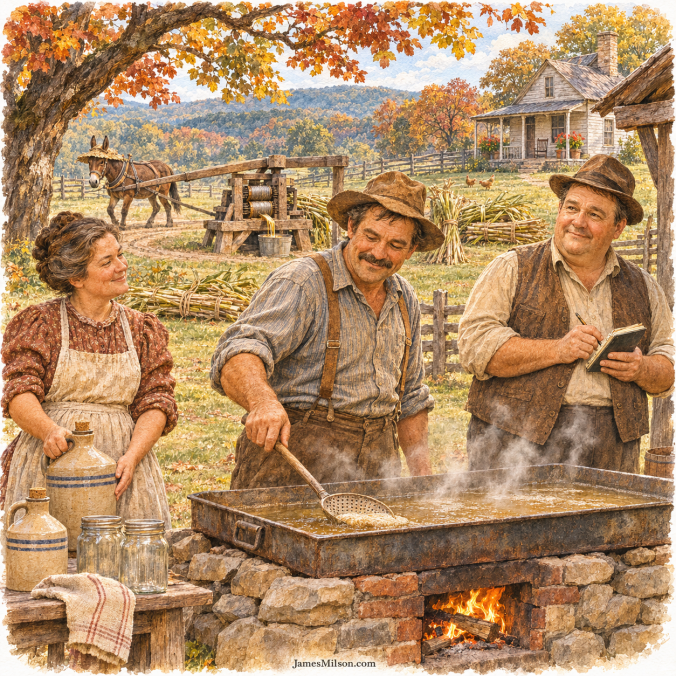
At the furnace, Emery lifted a long-handled skimmer and drew foam from the surface of the simmering juice. Small bubbles crowded together, broke, and formed again. Steam curled past his sleeves.
Much of the water in that thin juice had to leave before syrup remained. The fire needed tending, the surface needed skimming, and the pan required a watchful eye. Emery studied the changing boil and lifted a little of the thickening liquid to judge how it ran.
Here was the transformation I had come to see.
The pale juice from the mill was becoming something darker, fuller, and fragrant enough to make a man remember that breakfast had been several hours ago.
I looked back toward the growing heap of crushed stalks.
“And what becomes of those?”
“Bedding for the animals, some of it,” Emery said. “Then back onto the fields with the manure. Dried stalks will serve for fuel, too. One way or another, it all goes to good use.”
“You get considerably more out of a stalk than a fellow might suppose.”
“Try to,” he said, and skimmed the pan again.
A familiar wagon rattle reached us from the lane. A moment later, Buck and Jenny appeared, bringing Ennis Greenlea into the yard.
“Smelled you working before I saw the house,” he called.
“Then your nose is keeping better time than your watch,” Nettie answered. “Your order’s ready.”
Ennis brought his team to a stop and climbed down. Nettie showed him the containers she had packed from an earlier batch — syrup already cooled and ready to travel, bound for a general store and a hotel kitchen in Packet’s Landing.
I had known the Watson name from the Butterfield Farmers Market. Here was another part of the journey: their syrup leaving the farm on an ordinary wagon, headed for breakfast tables they might never see.
Ennis settled the containers carefully among his other goods.
“Any shortage of customers?” I asked.
“Biscuits,” he said. “Occasionally a shortage of biscuits. Never heard anybody complain of too much syrup.”
He paused beside Chester before leaving.
“Fine hat.”
Chester continued around the mill.
“Doesn’t care for remarks about his clothes,” Emery said.
Ennis touched the brim of his own, returned to the wagon, and presently the sound of wheels faded down the lane.
Work settled around us again. Emery fed more cane into the rollers. Nettie checked the containers by the house. Smoke lifted above the furnace, and the syrup in the pan deepened toward a rich amber-brown.
By the time Nettie appeared with a small plate, I had watched enough work to feel that accepting a biscuit was almost a professional obligation.
She split one while it was still warm, spread butter across it, and spooned syrup from a finished batch across the open halves. It settled into the crumb and gathered along the edge in a glossy ribbon.
“There,” she said. “You’ve looked at it long enough.”
Emery joined us while the fire was quiet, keeping the pan within sight.
I took a bite.
The syrup had a deep sweetness with a flavor of its own, warm against the butter and tender biscuit. I understood immediately why people came back to the Watsons’ market table.
For a moment, I neglected my questions.
“Well?” Nettie asked.
“I believe,” I said, “that I may need another bite before reaching a conclusion.”
She handed me a napkin.
“Most folks do.”
When I see a jar of Watson sorghum this November, I shall remember that morning — the pale juice beneath the rollers, Emery watching the pan, Nettie packing an order, and Ennis carrying a little sweetness down the road.
And Chester, of course, making his patient rounds beneath a straw hat.
I left with a jar for my own table.
The biscuit did not travel nearly so far.

Original artwork throughout The Front Porch has been created from my concepts and creative direction with the assistance of AI.