MEANWHILE, AROUND HONEY HILL COUNTRY . . . .
Along the Roads with Ennis Greenlea
“A Few Things Before Thanksgiving”
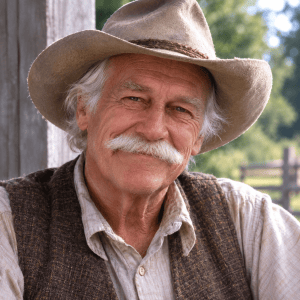
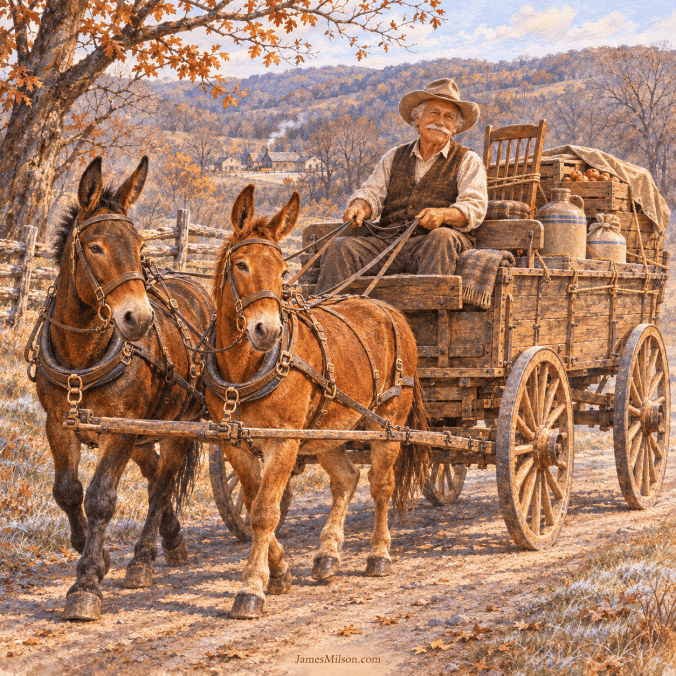
Ennis Greenlea travels the roads of Honey Hill Country with his mules, Buck and Jenny, hauling what needs hauling and noticing what needs doing. His work brings him to farms, shops, kitchens, and doorsteps, where a delivery often becomes a visit and a little extra help can make somebody’s day easier.
Join him each month for the people, places, and unexpected kindnesses found along a working neighbor’s route.
By Ennis Greenlea
The chair was the first thing aboard that morning.
I collected it at Weber’s Wood Works in Butterfield, where August Weber — Gus to most everybody — had repaired a loose rung. He had it standing beside his workbench when I arrived, clear of the curled wood shavings gathered beneath a partly finished cupboard.
“Ready?” I asked.
“For sitting, ja.”
He turned the chair over, checked the repaired joint with his strong thumbs, then set it upright and pressed firmly on the seat. All four legs stood square.
“Another twenty years, this one,” he said. “If they keep it off two legs. Not for porch settin’ anymore, you see.”
“I’ll tell them.”
“They will lean back anyway. But you tell them.”
It was a plain wooden kitchen chair, its seat polished by years of use. Mrs. Bell had asked me to collect it for her. It belonged to her sister, who had arranged the repair and agreed to lend it for Thanksgiving.
“Company coming?” I had asked her.
“More than I had chairs for.”
“How many more?”
“One. Unless somebody brings somebody.”
I wrapped an old blanket around the chair and secured it near the front of the wagon, where it could travel without rubbing against the crates.
Gus watched me fasten the last rope.
“Her sister says she wants it back.”
“I expect she does.”
“With the same number of legs, preferably.”
That seemed a fair condition.
By the time I climbed onto the wagon seat, Buck and Jenny were ready to hear less about furniture and more about getting underway. I checked the load once more, gathered the reins, and we rolled out into a November morning that had left a little frost along the shaded fences.
There was room beneath the tarp for apples, a place reserved for cider, and a sack of pecans tucked behind the chair for Myra Cookson’s Pie Pantry & Goodies Shoppe in Butterfield. A few smaller deliveries were tucked where I could reach them without unpacking the whole wagon.
November loads take some arranging. Nobody wants a chair leg through the flour.
The leaves had thinned enough that I could see houses from stretches of road where, a month before, there had been nothing but branches. Woodpiles stood higher beside the porches. Here and there, a curl of smoke rose straight until it found a breeze above the rooftops.
Passing the Watson lane put me in mind of an earlier Autumn pickup.
Emery and Nettie had been making their Sweet Sorghum Syrup that day, and Henry Calder was there learning how it was done. Chester was turning the mill in his straw hat, looking better dressed for the occasion than some people I have hauled.
Henry had his notebook out while we loaded the syrup. I learned afterward that Nettie had brought him a warm biscuit before he left.
A man can choose worse work than visiting Nettie Watson with a notebook.
This morning, however, my next stop was Pritchard’s Orchards.
The proper name is Red Gate Orchards, and the old red wooden gate makes it easy enough to find. Most of us have called it the Pritchards’ place for so long that Walter answers to either.
Buck and Jenny knew the turn into Red Gate Orchards well enough. Whether that was because of the red gate or the occasional apple that found its way into their feed, I could not rightly say.
Jenny began the turn before I had finished asking.
Walter was beside the packing shed when we came in, lifting the lid from a crate. Clara stood nearby with a pencil and a list, checking destinations.
“Morning, Ennis,” Walter said. “Good road?”
“Good enough coming in. I’ll know more about going out once you’ve filled the wagon.”
He looked over the side.
“Taking somebody’s dining room along?”
“Just the overflow.”
Clara glanced at the chair. “Thanksgiving?”
“Yes.”
“Thought so. We’ve been counting ours.”
The last of the picking was behind them, although there was still plenty of orchard work in sight. Empty baskets stood nested beside the shed, and apples waited in shallow trays for sorting. Beyond the fence, the rows of trees were mostly bare, with a few stubborn leaves hanging where the morning sun reached them.
Walter lifted an apple from a tray, turned it in his hand, and set it aside.
“That one won’t keep.”
It looked respectable to me until he showed me the bruise.
“Fine for using soon,” he said. “Just don’t put it away and forget it.”
Clara was checking the next tray.
“The keeping apples get the cool quarters,” she said. “These get acquainted with the kitchen.”
Walter began explaining which of their apples lasted best through Winter. He had been a man of few words when I drove in. Once we reached the subject of apples, there was no further shortage.
He showed me how carefully they handled the fruit intended for storage, and how they kept watch for one beginning to spoil.
“You want to find it before its neighbors suffer,” he said, lifting another apple from the tray.
“I’ve hauled people like that.”
Clara smiled without looking up from her list.
We loaded the crates with their destinations facing where I could read them. Some were bound for shops, and others for kitchens where Thanksgiving baking would soon be occupying every useful surface.
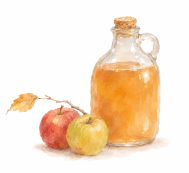
A separate lot of sound apples was being set aside for Hiram Tesereau’s Old Cider Mill. The Pritchards had already sent him several loads during the harvest, and containers of freshly pressed cider from their latest batch stood ready for me to take into Butterfield.
Walter rested a hand on one of the apple crates.
“Good crop this year.”
“And now,” Clara said, “we’re trying to get it safely sold before Walter stops to explain every apple.”
“He asked.”
“He asked where you wanted the crate.”
Walter considered that, then helped me lift it aboard.
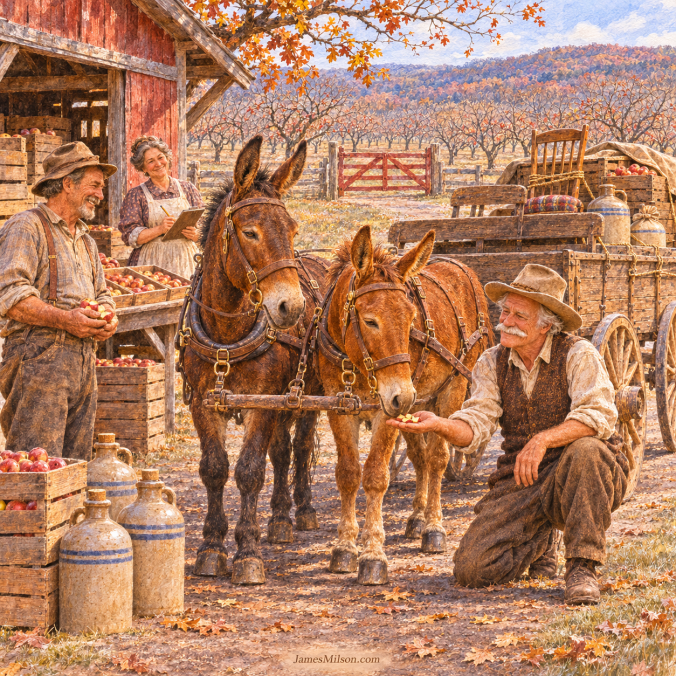
Before I climbed back onto the seat, he selected two sound apples with small bruises and cut them into pieces for Buck and Jenny.
“Those won’t keep,” he said.
“Neither will these two, if they know you’ve got apples.”
Jenny was already watching his hands.
Buck accepted his share with considerably more dignity, although he checked my empty palm afterward to make certain the arrangement was complete.
I watered the team while Clara made her final count. Then she handed me the delivery list.
“Apples here, cider there,” she said, pointing to the names. “And the chair wherever it belongs.”
“Most important thing on the wagon.”
“Most important after my apples and cider, you mean.”
“Of course. That’s what I meant.”
We left Walter and Clara beside the shed and took the road toward Butterfield.
A little farther along, I stopped with a parcel of hinges and screws for Harlan Weatherby, who had been promising himself all Autumn that he would mend a loose barn door.
He was working on it when I arrived.
“Cold wind finally persuade you?” I asked.
“Door came open last night.”
“That would do it.”
“Woke me up twice banging in the wind. Third time, I got dressed.”
He tried the door against its frame while I held the parcel. It shut squarely enough, but the old latch needed lifting into place.
“I’d rather fuss with it now than when there’s ice under my feet,” he said.
Behind the house, his wife was directing the last of a load of split wood beneath the porch roof. She called for him to come and look at something.
He glanced toward her, then at the hinges.
“Winter’s getting close.”
“So I hear.”
He took the parcel and went to see what else needed doing.
By the time we reached Butterfield, the sun had warmed the wagon seat, although the air still had a sharp edge when we turned into the shade. I made the apple and cider deliveries, giving Buck and Jenny a rest between stops, and then drew up outside Myra Cookson’s Pie Pantry & Goodies Shoppe.
There are places where unloading is improved by the smell coming through the door.
Myra’s is one of them.
She met me as I carried in the pecans, wiped her hands on her apron, and inspected the sack.
“Good. I’ve been waiting for these.”
“Thanksgiving business?”
“That, and Myrtle Mae Meadowbloom is coming to make pie.”
I lowered the sack onto the place she indicated.
“Would there be any advantage in arranging another delivery that day?”
“To whom?”
“Anybody in this neighborhood.”
Myra gave me a look that suggested she understood the full extent of my business planning.
“If there’s pie to spare, Ennis, I’ll remember you.”
I thanked her and stepped outside before she found something else for me to carry.
The chair was my last delivery.
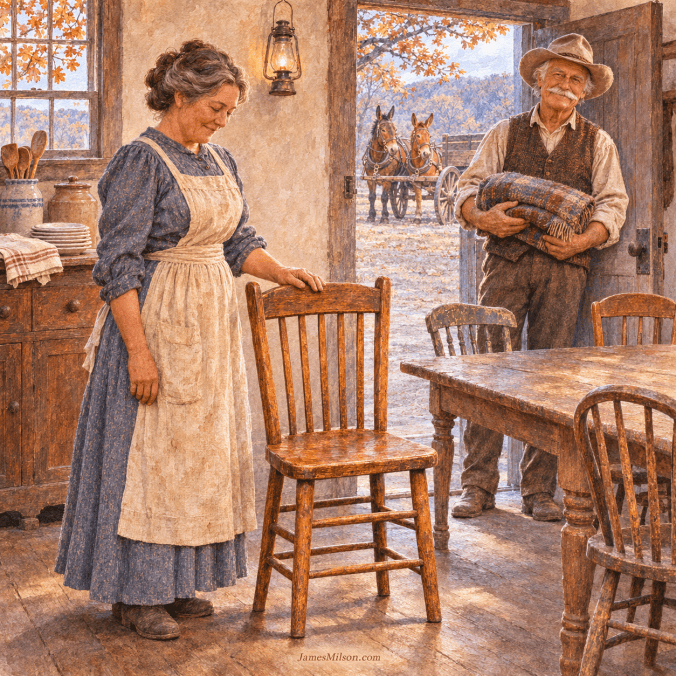
Mrs. Bell came onto the porch while I unfastened it. She ran a hand over the repaired rung, then carried it inside to the kitchen table.
I followed with the blanket.
“Will that do?” I asked.
She set the chair in place, stepped back, and counted.
“Just right.”
From the doorway, I could see that the table had already been pulled out farther than usual. A folded tablecloth lay on the sideboard, with a small stack of plates beside it.
“Your sister says she wants it back.”
“She’ll get it.”
“She was particular about that.”
“She always is.”
Mrs. Bell looked once more around the table.
“I have enough chairs now unless somebody brings somebody,” she added.
Outside, Buck and Jenny were standing in the afternoon light. The wagon looked larger with the day’s business gone from it. I folded the blanket, tucked it beneath the seat, and climbed aboard.
We took the home road at an easy pace.
There was harness to put away, feed to see to, and a latch of my own that would benefit from attention before freezing weather. I had been hearing it rattle for a week.
Behind me, the empty wagon gave a familiar creak.
For most of the day, I had been careful of that chair. Now it was standing at a kitchen table, waiting for somebody to come home for Thanksgiving.
Original artwork throughout The Front Porch has been created from my concepts and creative direction with the assistance of AI.