Sometimes a Picture Tells You the Story

Welcome back to the Front Porch.

You have probably heard the old saying, “A picture is worth a thousand words.”

I’ve been thinking lately that sometimes a picture does something else. More than that.

Sometimes it tells you where to find the words.

That thought came back to me recently while working on something you may never think much about when looking at a finished illustration . . . . Just what should a steam locomotive arriving at a small Ozarks town in 1904 actually look like?

Seems like a simple enough question, doesn’t it?

Put a locomotive on some railroad tracks, add a station, maybe a few people standing around, and there you go. Well — apparently — that isn’t how things work around here.

Because once I started looking more closely at the trains that would have traveled through Honey Hill Country at the beginning of the twentieth century, one question led to another. And another. And another . . . . And then another.

Before long, I was looking into steam locomotives and passenger cars, freight cars and railroad crossings, station platforms and loading areas, horse-drawn wagons and mule teams, and the wooden water tanks that stood alongside railroad tracks all across the country.

All of this, mind you, because I wanted to create a true-to-the-period image of a train.

Funny thing is, I had been down this road before — although the first time, there wasn’t a train anywhere in sight.


Continue reading

On Fiction Writing and the Art of Respectable Lying

Welcome back to the Front Porch.

Please pull up a chair for a few minutes and make yourself comfortable. Today I’d like to make a confession — one that may permanently damage my reputation as an honest fellow.

I’ve been lying to perfectly nice people for years.

Professionally.

Now before anyone becomes too alarmed, I’m talking about the respectable, old-fashioned kind of lies. The harmless sort that begin with, “Once upon a time . . . . “ and somehow end with everybody smiling.

Mark Twain is often credited with saying that if you want to become a good fiction writer, you must first become proficient at the art of lying. Whether he actually said those exact words or not, I’ve never been entirely sure. But I’ve always had a difficult time believing he’d object to the sentiment, and cannot argue with it myself.

The longer I’ve been writing, the more I think there may be more than a little truth hiding inside that mischievous observation.

After all, I’ve spent years convincing otherwise sensible people that a talking bear in the Ozarks backwoods wears overalls, a bloodhound interviews a talking mule, a goat develops an unhealthy appetite for hats, and somewhere in a fictional place called Honey Hill Country there are folks who seem just a little more interesting than anyone has a right to be.

And the surprising part?

People keep believing every word.

The curious part isn’t that writers tell these respectable lies.

It’s why perfectly sensible people keep smiling . . . . and asking for another one.

And well . . . . that’s where the real story begins.


Continue reading

The June 1904 Issue of Hearth & Holler Has Arrived

Today marks the beginning of something new.

After much thought, planning, writing, illustrating, and more than a few cups of tea, Hearth & Holler has taken on a new format as a Monthly Magazine — a collection of stories, people, places, gardens, recipes, traditions, and adventures from across Honey Hill Country.

For readers visiting Honey Hill Country for the first time, the stories and features in Hearth & Holler are set in the fictional world of Honey Hill Country in the year 1904, the home and time period of my primary story character Little Red Bear. Through the eyes of its residents, contributors, and occasional bears and animals, we explore a simpler time filled with gardens, front porches, festivals, railroads, riverboats, animals and humans living side-by-side, and everyday life.

Inside this month’s issue you’ll meet one of Honey Hill Country’s most beloved shopkeepers, climb to Inspiration Point with Willow Meadows, visit a Jeffersonian garden in bloom, enjoy strawberry season at the Packet House Hotel, and travel with Felicity Merriweather to the St. Louis World’s Fair.

You’ll also find hummingbirds, festivals, good-natured nonsense, front porch reflections, and a few surprises along the way.

Rather than presenting everything in a single post, each feature now has its own page, allowing readers to explore the magazine much as they might wander from article to article in a traditional publication.

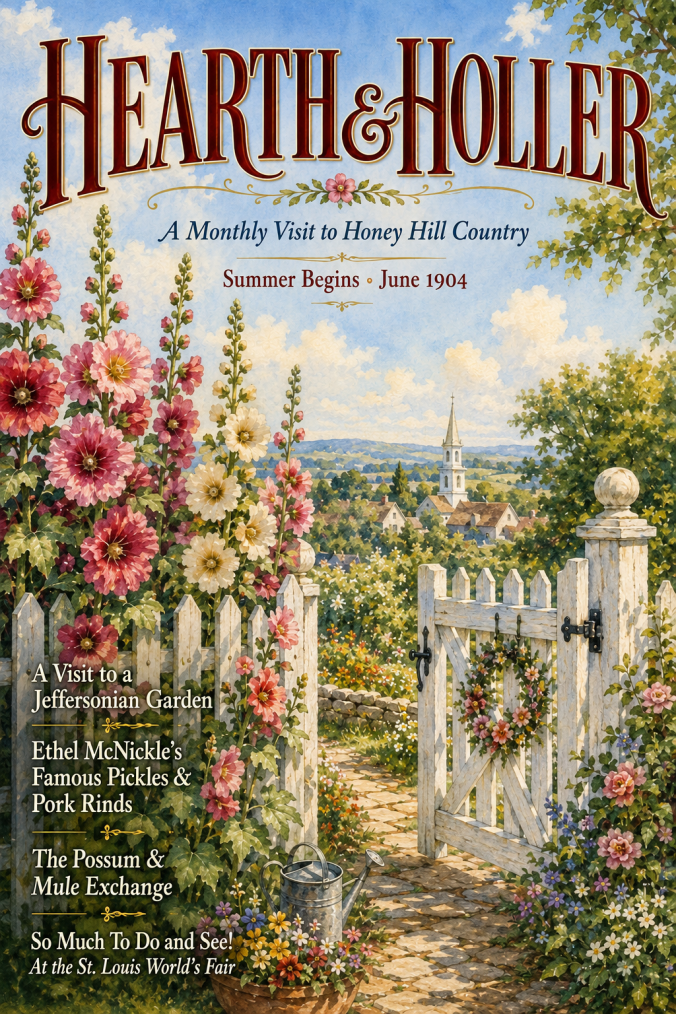
I invite you to pour yourself a cup of something good, settle in, and spend a little while with us in Honey Hill Country.

👉 Click here to visit the June 1904 issue of Hearth & Holler.

Thank you for visiting and spending part of your day with us!

— Jim  (and Red!)
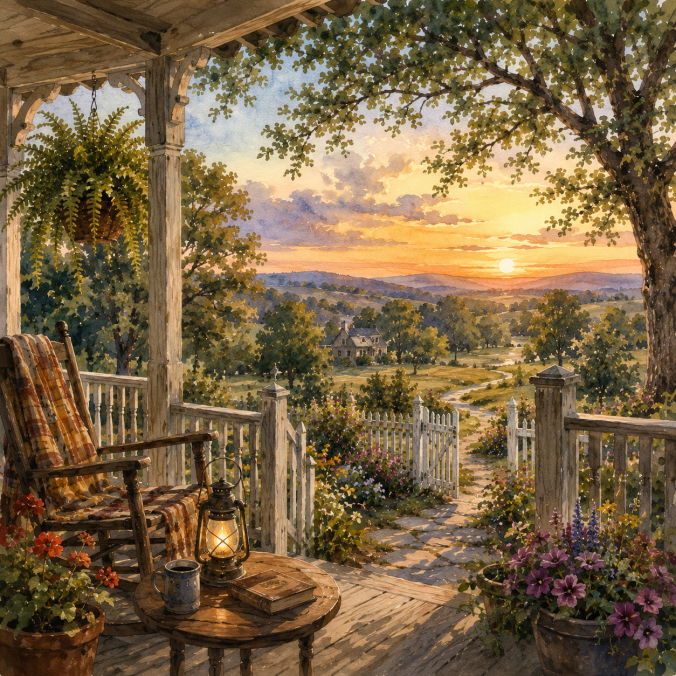
The illustrations accompanying this issue were created with the assistance of AI and lovingly prepared in a watercolor style for the world of Little Red Bear and Honey Hill Country.

Why Small Stories Last

Why the Little Things Stay With Us

Small stories. Small moments. Small actions that reverberate through the years, often in ways we never fully realise at the time.

My own writing life — if one can call it that — began in the fourth grade, with a teacher named Mrs. Drew. I do not recall her first name, if I ever knew it at all. Back then, adults were simply Mr., Mrs., or Miss, and that seemed sufficient. (You need not bother doing the arithmetic — I am seventy-six.)

One afternoon near the end of the school day, Mrs. Drew propped a landscape painting against the blackboard for all of us to see. Our assignment was simple enough — write a short story inspired by the scene in the painting. It showed a family in a wagon, travelling along a dirt road that wound through woods and farmland, headed somewhere beyond the frame.

We began writing in class and were sent home to finish. A few days later, Mrs. Drew returned our papers, handing them back one by one. All except mine. Mine, she kept.

When she finally explained why, it was because she intended to read it aloud to the class. And when I eventually received it back, there at the top of the page were words I have never forgotten:

“A++      Jim — You will be a writer someday.”

I was painfully shy at the time. I did not know what to do with such encouragement. But I carried it with me — quietly, steadily — for the rest of my life.

There are moments like that — small at the time, almost unnoticed — that stay with us long after louder things have passed. They do not announce themselves. They do not demand attention. And yet, years later, they are often the ones we remember most clearly.

Perhaps it is because they arrive without agenda. Or because they involve people rather than events. Or because they ask nothing of us except that we notice.

Continue reading

My Year-End Reflection & Looking Ahead

On Writing, Story, and the Road Ahead

As the year draws to a close, I find myself less inclined to sum it up than to simply set it down — like a coat hung by the door at the end of a long day. Some years ask for that. Not a tally, not a verdict, just a moment to breathe before turning toward whatever comes next.

Earlier this week, I shared a few thoughts meant simply to steady the heart as the year turns. This piece is something a little different. Less about what has been weathered, and more about what has quietly taken shape along the way.

Continue reading

Introducing “The Hearth & Holler Gazette”

A Small-Town Paper from Little Red Bear’s Honey Hill Country

Before we get too far along, there is one small thing I would like to settle right from the start.

These days, the moment someone hears the words “weekly” and “email,” a little voice pipes up:

Oh no… not JAN.

Just Another Newsletter.

You know the kind.
Crowded inbox. Loud subject lines. Endless self-promotion.
More noise than nourishment.

And if that is what The Hearth & Holler Gazette were going to be — I would not blame you one bit for steering clear.

But here is the thing —
This is not JAN. Not even close.

The Gazette is not a newsletter.
There will be no book pitches.
No launch announcements.
No character reveals dropped like bait.
No “Pre-order Now!” or “Don’t forget to buy!” reminders elbowing their way into your morning.

Instead, think of it this way —

The Hearth & Holler Gazette is a fictional small-town paper, delivered once a week on Saturday mornings, the way such things used to be — its pages set in the early years of the twentieth century, beginning in January of 1904.

A place for:

  • Short Stories and Sketches
  • Bits of Humour
  • Kind News
  • Happenings and Events from Little Red Bear’s Honey Hill Country
  • Old-fashioned Advertisements that Exist Only for the Smile
  • And the sort of Gentle Company you might enjoy with a cup of coffee while the house is still quiet

It exists for one reason only —

To offer a pause.
A smile.
A little warmth.

That is the why.
Everything else grows from that.

One might think of The Hearth & Holler Gazette as something closer to Garrison Keillor’s Prairie Home Companion
without the live music, and without needing to go buy a radio.

A familiar voice.
A small town and folks you come to know.
Stories and observations that take their time, and trust you to do the same.

Or perhaps it brings to mind Charles Osgood’s quiet pieces — the kind that never shouted for attention, yet somehow always earned it.

If you ever found comfort in evenings spent with The Andy Griffith Show, The Waltons, or Little House on the Prairie, then you already understand the spirit at work here.

Not because those stories ignored the wider world —
but because, for a little while, they set a different table.

That is the neighbourhood the Gazette hopes to live in.

Continue reading