PULL UP A CHAIR — IT’S STORYTIME
A Visit with the Bookers — Isaiah & Evelyn
“The Buck Stops Somewhere Else”
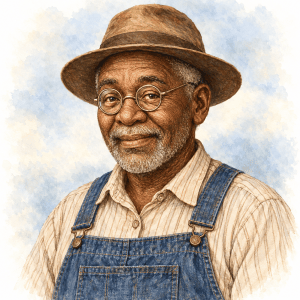
Isaiah and Evelyn Booker welcome readers into the easy company of neighbors who know the value of a good story and a listening ear. Isaiah generally has a tale ready, while Evelyn has a sharp memory, a warm welcome, and a few observations of her own about the way he tells it.
Isaiah enjoys giving a story room to unfold. He knows when to pause, when to lower his voice, and when to let his listeners decide what might have happened next. Whatever turns the telling takes, his affection for the people gathered around him is never far beneath the surface.
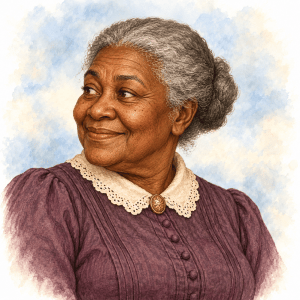
Evelyn brings her own lively understanding of people to every visit. She listens closely, speaks her mind, and can bring a wandering tale back to earth with a few well-chosen words. Her kindness has a practical side, too — especially when somebody needs another cookie, a little reassurance, or a reminder that it is getting late.
Join them each month for porch-side visits, local recollections, laughter, and the sort of stories that give folks something to carry home besides an empty plate.
A Visit with the Bookers — Isaiah & Evelyn
“There is a buck in these hills,” Isaiah Booker announced, “that has been hunted by three generations of the same family.”
“Two,” Evelyn said.
“Three, counting the boy.”
“The boy went along once. He carried sandwiches.”
“He came home without a deer, same as the others. That counts.”
The children laughed.
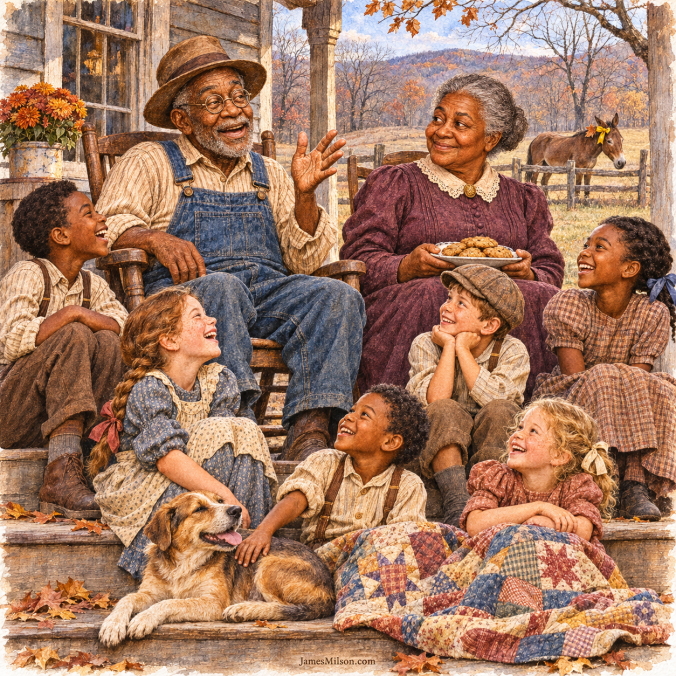
They had gathered on and around the porch steps that November afternoon, boys and girls, with the youngest sharing a folded quilt beside the bottom step. Roper lay where several small hands could reach him without anybody having to leave the story.
Beyond the yard, Mickie stood beside the pasture fence.
Evelyn had tied a fresh yellow bow on the retired mule that morning. Mickie had since acquired a dry leaf beside it, which nobody had yet persuaded her to surrender.
One of the older boys leaned forward.
“How big a buck?”
“Nobody agrees entirely about his size,” Isaiah said. “Some say ten points. Others say twelve. One fellow reported fourteen, although he was looking through branches.”
“Was he counting the tree?” a girl asked.
“We have never settled that.”
Evelyn passed the cookie plate.
“The general understanding,” Isaiah continued, “is that he is a White-tailed Buck of considerable age, exceptional judgment, and no particular interest in meeting anybody.”
“Has anybody seen him?”
“On wooded ridges. In creek bottoms. Along brushy field edges. Once behind a man who had spent the morning watching for him in the opposite direction.”
A boy grinned.
“Did the man turn around?”
“No.”
“How do you know the deer was there?”
“Two companions saw him.”
“The man himself disputes it,” Evelyn added.
“He would,” Isaiah said.
“Maybe his friends made it up.”
“Not until afterward. The original part was true.”
Isaiah settled comfortably into his chair.
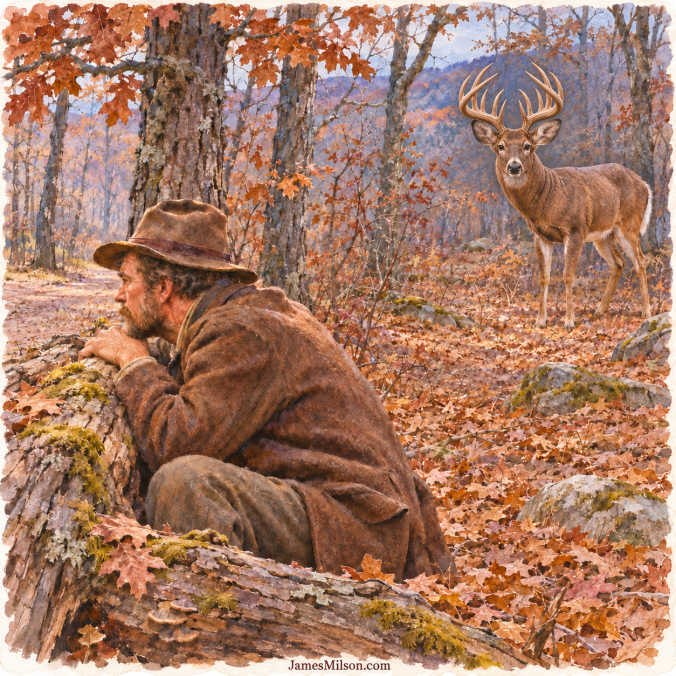
According to the account, the hunter had chosen a crossing where the buck was certain to pass.
He knew this because he had studied the tracks, considered the wind, and explained the arrangement to everybody before daylight.
“He settled behind a fallen tree,” Isaiah said. “His companions took positions farther along the ridge. Presently, the buck appeared behind him.”
“How close?” one boy asked.
“Close enough for both companions to see the antlers, the broad shoulders, and their friend carefully watching an empty patch of woods.”
“What did the deer do?”
“Looked at him awhile. Then went away.”
The children enjoyed that.
“The hunter maintained that nothing could have passed behind him without his knowing,” Isaiah continued. “His companions said that appeared to be the principal difficulty.”
Evelyn folded her hands.
“They have discussed it every Autumn since.”
“Has he caught the deer yet?” the youngest girl asked.
“If he had,” Isaiah said, “this would be a shorter story.”
Roper stretched one foreleg beneath the step.
A boy moved his shoe to make room.
“Then there was the matter of the two brothers and the hollow,” Isaiah continued.
One brother had stationed himself near the upper end. The other waited below. They had worked it out carefully.
If the buck went downhill, the lower brother would see him.
If he went uphill, the upper brother would see him.
“And if he went sideways?” Evelyn asked.
“That was brought up afterward.”
The upper brother saw him first, moving down through the trees.
A little later, the lower brother saw him heading up.
Neither saw him again.
“When they compared accounts, each accused the other of sending the deer back,” Isaiah said. “By supper, they had established that the animal had gone both directions, remained nowhere, and probably understood the hollow better than they did.”
“What did their daddy say?” a girl asked.
“That last part had already been established years before.”
One of the older boys leaned back against a porch post.
“Could have been two deer.”
“Certainly,” Isaiah said. “That explanation has been offered.”
“Seems reasonable to me,” another agreed.
“It does. Until you hear how carefully both brothers described the same crooked little point on the left antler.”
Evelyn looked at him.
“Was it the left?”
“Depending upon which way he was facing.”
“That does complicate identification.”
The girl beside the post held up her left hand, turned it around, and studied it.
Evelyn smiled at her.
“His left stays his left, sweetheart. Even when Mr. Booker is telling it.”
Isaiah waited for the laughter to settle.
“The old fellow’s antlers have become a subject of study among people who have never had enough time to study them,” Isaiah added.
Some remembered a crooked point. Some remembered a pale mark above one eye. Others remembered only that there had been considerably more deer than they expected.
“The accounts grow less clear with repeated telling,” he admitted.
“I have noticed that,” Evelyn said.
“Is he magic?” the youngest boy asked.
“No need for magic,” Isaiah replied. “A nose that finds you before your eyes find him. Ears that catch a boot scraping stone. Paths through cover where a man sees nothing but an unreasonable quantity of brush.”
He pointed toward the woods.
“A hunter may spend one morning learning a ridge. The deer lives there.”
The children looked beyond Mickie’s pasture.
“Does he know where everybody is?”
“Likely knows more about that than they know about him.”
Mickie flicked an ear.
The leaf stayed.
“After enough unsuccessful mornings,” Isaiah continued, “people begin giving him credit for things no deer ought to know. One man said the buck waited until he opened his dinner parcel before crossing the clearing.”
“Maybe he wanted a biscuit,” a boy suggested.
“Another claimed the deer appeared only on days when he stayed home.”
“How would he know?” Evelyn asked.
“His neighbor told him.”
“About the deer?”
“Every time.”
She nodded.
“That would wear on a person.”
Isaiah rested his hands on his knees.

“I have had my own encounter with the animal.”
Every child looked back at him.
Evelyn looked toward the yard.
“I had found a likely place,” he began, “where an old logging track came down through the timber.”
“You found a comfortable stump,” Evelyn interjected.
“It commanded a useful view.”
“Of your dinner.”
The children giggled.
“A man sitting quietly in the woods must occasionally move his hands,” Isaiah explained. “Otherwise, he stiffens.”
“Especially if he has brought ham biscuits,” Evelyn said.
“There had been biscuits. I have never denied that.”
“How many?” a boy asked.
“That has no bearing upon the deer.”
“How many did you bring home?” Evelyn asked.
“That has even less.”
He continued before anybody could pursue the matter.
“I was reaching for the second when I heard a sound beyond the clearing. A small sound. The sort that causes a man to stop chewing and attend to his surroundings.”
A little girl lowered her cookie.
Isaiah nodded toward her.
“Exactly.”
He had looked up.
Across the opening stood a buck.
“He had come out so quietly that I could not have said where the woods ended and the deer began.”
For a moment, neither had moved.
Then the buck’s ears turned.
His head followed.
He stepped behind a screen of young trees, and that was the end of it.
“Did you get a good look?” somebody asked.
“Good enough.”
“At the antlers?”
“They were substantial.”
“How many points?”
“Twelve.”
Evelyn turned back toward him.
“You told me ten.”
“I had time to think about it afterward.”
“You had time to finish the biscuits.”
“Both things can be true.”
One boy raised his hand.
“My uncle told that story.”
“That supports my account,” Isaiah said.
“He said you were asleep.”
“Well, that was a different part of the morning.”
The porch filled with laughter.
Roper lifted his head to see whether it concerned anything edible.
Finding no immediate opportunity, he moved away from the children and steps. He stood near the yard gate, looking toward the far fence.
Evelyn noticed him first.
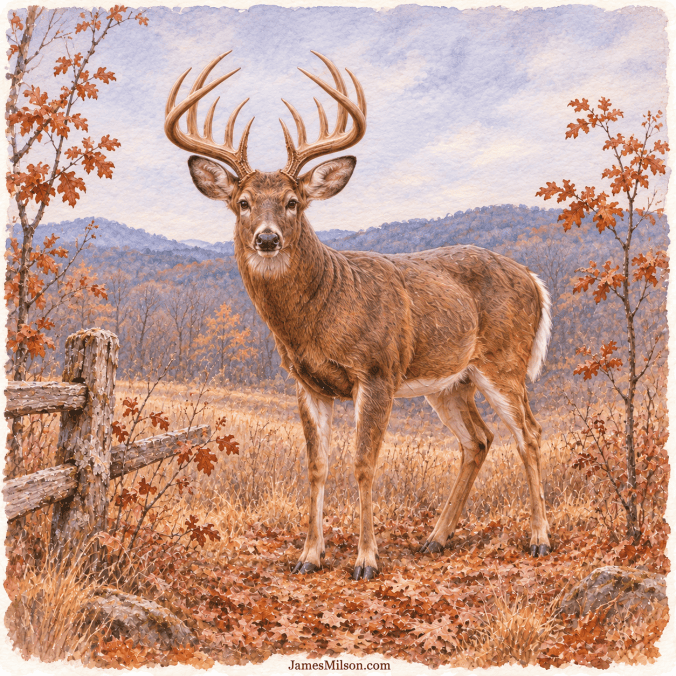
Beyond the fence, a magnificent buck had stepped from the woods. He stood quietly beside the brush, his antlers clear against a patch of pale November sky.
Mickie turned one ear toward him.
The buck watched the porch.
The children were watching Isaiah.
“How can you be sure it’s the same deer?” the older boy asked.
Isaiah lifted a finger.
“A truly experienced woodsman does not require a long look.”
“Isaiah,” Evelyn whispered.
“Just a moment. I’m answering the boy’s question, Evelyn.”
“Isaiah,” she whispered again.
“The important thing is knowing what to notice.”
She tapped his elbow.
“Isaiah.”
“And remembering it accurately afterward,” he continued.
Evelyn stood.
That got his attention.
“What?”
“Turn around.”
They all did.
Roper was still watching the fence.
Beyond it stood a patch of brush, two young Oaks, and the beginning of the woods.
Nothing else.
“He was right there,” Evelyn said.
“Who?”
“The buck.”
The children scrambled up from the steps.
“Big one?”
“Yes.”
“Antlers?”
“Of course antlers.”
“How many points?”
“Twelve.”
Isaiah studied her.
“You counted them?”
“I had time.”
“Anybody else see him?”
She looked at Roper.
Roper looked at the fence.
Mickie lowered her head to the grass.
“Well,” Isaiah said, “you can understand how these stories get started.”
Evelyn looked at him for a considerable while.
He moved his chair out of the sun.
At least, that was the reason he gave.
Before the children left, they examined the fence from the yard side and asked Evelyn to show them exactly where the buck had stood.
She pointed.
The youngest girl studied the opening.
“I believe you, Mrs. Booker.”
“Thank you, sweetheart.”
“Roper does, too.”
That appeared to settle it for her.
The children went home with a new sighting to discuss and several opinions about the biscuits.
Evelyn went inside.
Isaiah stayed on the porch a little longer.
There was no movement beyond the fence.
No sound from the brush.
Still, before he went in, he took one more look.
Somewhere out there, a deer knew exactly where they had spent the afternoon.
They could not say the same about him.
Original artwork throughout The Front Porch has been created from my concepts and creative direction with the assistance of AI.