OFF WE GO! HERE, THERE, & EVERYWHERE!
Exploring the Wider World Beyond Honey Hill Country with Felicity Grace Merriweather at the Louisiana Purchase Exposition, the St. Louis 1904 World’s Fair
“Supper Above the World“
Felicity Grace Merriweather possesses an insatiable curiosity about the wider world.
From grand expositions and remarkable inventions to distant places and extraordinary people, she delights in bringing readers stories, discoveries, and adventures from beyond the familiar hills and hollers of Honey Hill Country.
I made a new friend at the Fair because I admired her notebook.
This seems a perfectly reasonable way to begin a friendship. It was what happened afterward that required some consideration.
We were waiting in a line to enter the Palace of Agriculture building that had advanced just far enough to encourage us, then stopped again. The lady ahead of me opened a little clothbound journal with an embossed border and a ribbon marking her place.
“What a lovely book,” I said.
She turned with a smile.
“And already much too full.”
She showed me a page crowded with writing, including several lines squeezed sideways along the margin.
“I have begun putting things wherever there is room.”
I held up my own notebook.
“I understand entirely.”
She put her hand on my arm and laughed. As did I.
Her name was Amelia Thatcher.
“Amy, please.”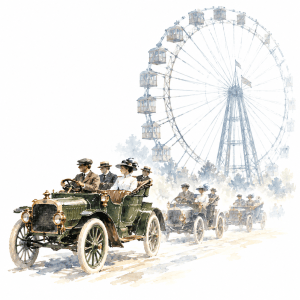
She came from Hannibal and was writing a weekly letter about the Fair for the Hannibal Evening Ledger. When I explained that I was gathering things to share with readers in Honey Hill Country, she asked what I had enjoyed most.
By the time we reached the front of the line, neither of us had finished answering.
Amy offered to show me the stall where she had bought her journal. We walked there together, talking about the difficulty of seeing everything, remembering half of it, and finding somewhere to sit before one’s feet began making decisions independently that they had done enough for the day.
She had medium blonde hair tucked neatly beneath her hat, a ready smile, and the comforting habit of stopping to write things down herself. I did not have to apologize whenever I reached for my pencil.
At the stall, I considered the journals while Amy waited beside me.
Then she said, “Would you care to join us for supper this evening?”
Several members of her literary society in Hannibal were visiting the Fair. They had arranged a small supper, and she had been invited to bring a guest.
“How very kind,” I said. “Where are you having it?”
She pointed.
I followed her hand upward.
And upward.
“The Observation Wheel.”
For a moment, I could think of nothing useful to say.
“The Ferris Wheel?”
“Yes. In the banquet car.”
I looked at the great circle turning against the sky.
“I had not realized supper could be so far away.”
Amy looked up with me.
“Neither had I when I accepted.”
It is one thing to admire the wheel from a comfortable distance.
It is another to stand beneath it knowing that you have agreed to get on.
Above us, the great steel framework rose into the afternoon sky. Enclosed cars hung around its circumference, each looking smaller as my eye followed them upward.
“Have you ridden it before?” I asked.
“No.”
I turned toward Amy.
“You sounded quite certain about it.”
“I was trying to,” she responded.
That was reassuring in a way I had not expected.
We stood a little closer together.
The car waiting at the platform was much larger than it had appeared overhead. There were windows, room for our gathering, and a table prepared for supper.
Someone had laid out napkins.
I found this encouraging. Surely people would not go to the trouble of folding napkins unless they expected a reasonably settled evening.
Amy introduced me to her friends, who welcomed me warmly. A little girl attending with her mother was already looking from window to window.
“Will we go right to the very top?”
“Yes, dear.”
“Higher than that building?”
“Yes.”
“And that one?”
Her mother was still answering when a gentleman near us offered a figure.
“Two hundred and sixty-four feet high.”
I looked at Amy.
She had heard him.
“There are thirty-six cars,” he continued, “with room for as many as sixty people in each.”
I looked around our cabin with renewed appreciation.
Our supper party was considerably smaller.
“The axle alone is about forty-five feet long,” he said. “Nearly three feet through. One tremendous piece of forged steel.”
He looked pleased.
I was trying to feel pleased.
“It is remarkable what engineers can do now,” he added. “The world is changing right in front of us.”
At that moment, our little part of the world began to move.
The platform slipped downward outside as I experienced a lifting sensation.
I knew, of course, that it was we who were going up. My understanding of this did very little to improve the sensation.
My stomach seemed to notice before the rest of me.
I put one hand firmly against the edge of my seat.
Beside me, Amy sat very straight.
“Quite smooth,” she said.
“Yes.”
We both looked ahead.
I closed my eyes.
This helped for several moments.
Then curiosity overcame good judgment, and I opened them.
We were considerably higher.
I had somehow expected the wheel to wait while I collected myself.
A roof lay below the window.
Beyond it were more roofs, paths, and people whose hats I could now see from above.
I had spent days looking up at the Fair’s buildings.
Now I was looking down upon them.
“Oh,” I said.
It was not much of an observation for someone carrying a notebook, but it was all I had ready.
Amy glanced out, then back toward the table.
“Oh,” she agreed.
Across from us, the little girl was having no such difficulty expressing herself.
“Mother, look! The people! Look how little they are! Is that where we walked? Can they see us? Do you think they know we’re up here?”
I suspected her mother had not yet had time to consider any of these questions.
“Sit back a little, darling.”
The child sat back.
Her conversation continued.
Our guide began pointing out the sights.
I tried to follow him.
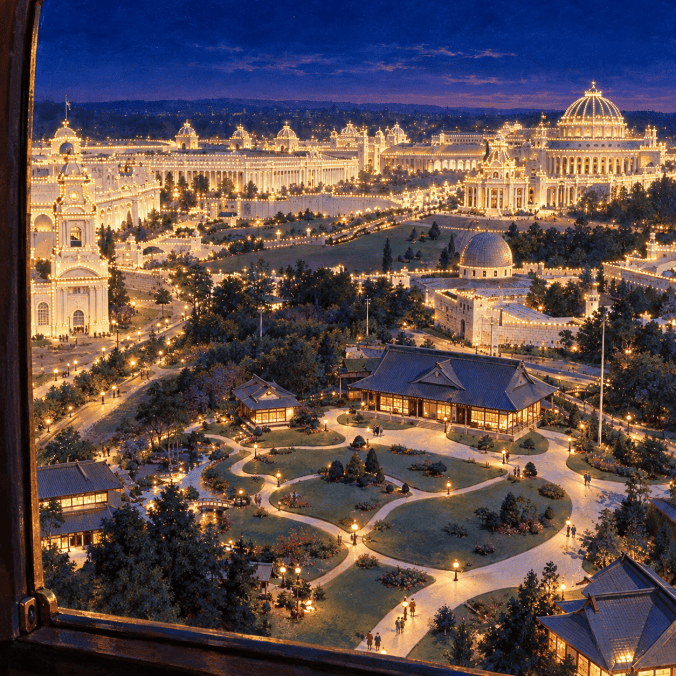
The white exhibition buildings spread across the grounds, with their towers, domes, and broad approaches. Water caught the lowering sunlight. Paths I had walked seemed to fit together differently from up here.
“There,” I said to Amy. “We were along there this afternoon.”
She looked.
For the first time, I understood where we had been in relation to everything else. I could see the spaces between the buildings, the crowds moving from one to another, and the great reach of the Fair beyond any single afternoon’s walking.
Then I looked too directly downward.
I drew back.
“Are you all right?” Amy asked.
“A little dizzy.”
“Look at me a moment.”
I did.
She was smiling, although one hand remained firmly on her seat.
“I am trying very hard,” she said quietly, “to behave like a woman who willingly invited someone to do this.”
That made me laugh.
It helped more than I would have expected.
Then the wheel stopped.
We were high above the grounds.
I waited for it to start.
It did not start immediately.
“Passengers getting on below,” Amy said.
“Yes. Certainly.”
We waited.
“I expect they have parcels,” I said.
“Possibly several.”
“And someone cannot find her ticket.”
“Almost certainly.”
We were inventing an entire difficulty on the platform below, but it gave us something to do while suspended above it.
I rested my hand beside hers.
Neither of us moved it away.
Someone passed the bread.
I accepted a piece because accepting bread was something I knew how to do.
The little girl asked whether anybody had ever been married on the wheel.
“Indeed they have,” one of our companions told her.
There was a wedding car, No. 19. Eddy Rogers and Florence Benton, a couple from Kansas, had been married on the wheel in May. Dozens of couples had been married at the top in the wedding car since.
Amy looked at me.
I looked out.
“Imagine arriving with a marriage license, a ring, and enough confidence for both the ceremony and the altitude,” Amy offered.
“I should have to be very certain of the gentleman,” I replied.
“Before accepting him?” Amy asked.
“Before agreeing to the location of the ceremony,” I clarified.
The little girl wanted to know whether the bride had looked down.
Nobody at our table could answer that.
I felt it was an excellent question.
When our car began moving again, Amy let out a small breath.
I realized I had been holding mine, too.
We had the car for the evening’s gathering, so our supper was not confined to one turn.
The first time we came down toward the platform, I felt a distinct sense of accomplishment.
Then we went up again.
Amy watched my face.
“Yes,” she said. “Again.”
“I see.”
But the second ascent was different.
I knew something of the movement now. I recognized a roof, then a tower. I could look outward without first looking down.
My hand had relaxed.
I discovered that I was holding my bread instead of my seat.
Supper proceeded. Plates were attended to, conversation resumed, and the gentleman who admired the engineering found a willing listener in the little girl.
She wanted to know what made the cars stay upright.
I listened, too.
That had become a subject of considerable personal interest.
On a later turn, I watched the ground fall away and felt a small thrill beneath the nervousness.
For a little while, with the view opening around us, it seemed we were floating on top of the world.
I said so to Amy.
She looked through the window.
“Yes,” she said softly.
Then she smiled at me.
“I am glad you came.”
“So am I.”
By then, I could say it without having to persuade myself.
Daylight softened.
The distant edges of the Fair grew less distinct, while lights began showing more clearly below.
At first, I noticed them along one building.
Then another.
As the evening deepened, bright outlines traced roofs, arches, and towers. Reflections gathered on the water.
Someone stopped speaking in the middle of a sentence.
We all looked.
I had seen electric lights before.
I had never seen anything like this.
The buildings appeared drawn against the evening in shining lines. Across the grounds, one illuminated shape led the eye toward another, with stretches of darkness between making the brightness more extraordinary.
I found myself leaning toward the window.
All afternoon I had been trying to comprehend the size of the wheel.
Now I was trying to comprehend the lights.
So many, burning steadily together.
No one walking along beneath them with a taper. No row of little flames bending in the breeze.
Electricity, carried through wires, making this immense place shine. It was a marvel revealed before my eyes.
The gentleman spoke again, more quietly this time.
“When I was that child’s age, I could not have imagined this.”
Nobody hurried to answer him.
Below us, reflections trembled where the water moved.
The little girl had grown quiet.
Her mother put an arm around her, and they looked together.
I forgot to take a bite.
For a little while, I forgot to be frightened.
Amy touched my sleeve and pointed toward another stretch of lights.
I nodded.
Neither of us reached for a notebook.
When we finally stepped out, I felt the platform beneath my shoes with considerable appreciation.
Overhead, the wheel continued its patient turning.
Amy and I stood aside while the others gathered their belongings. We agreed to meet again before long. There were still buildings we wished to visit, and now we each had someone with whom to compare notes.
“Next time,” I said, “you must let me invite you.”
“I should like that,” she responded.
“I will find somewhere pleasant.”
She looked up.
“On the ground?”
“To begin with.”
“Not beneath?”
“Perhaps.”
We laughed, then stood for another moment looking at the wheel.
I could pick out a car climbing toward the upmost place where we had been.
Earlier, I had wondered how I would manage to go up.
Now I was watching someone else travel toward a view I wished I could see again.
Later, I opened my notebook.
I wrote down Amy’s name, the supper, the wedding car, and the figures I had been told.
Then I paused.
Two hundred and sixty-four feet could tell you how high we had gone.
It could not tell you what it meant to open my eyes and find a rooftop beneath me.
Nor how it felt when Amy confessed that she was frightened, too, and the evening became easier because we no longer had to pretend.
I had gone to the Fair expecting to fill notebooks.
That evening, I came away with a friend, a view I could scarcely put into words, and the knowledge that I had been braver on the second ascent than the first.
Before closing the book, I added one more line.
Ask Amy where she would like to go next.
Original artwork throughout The Front Porch has been created from my concepts and creative direction with the assistance of AI.