One of the things I have discovered while putting together the new Hearth & Holler monthly magazine is that creating a magazine set in 1904 often requires learning things I never expected to know. Or having the need to know. Welcome to magazine week.
Most people probably assume magazine week involves writing articles, selecting images, correcting spelling mistakes, and occasionally convincing fictional contributors to stay within the boundaries of proper grammar and word limits.
And they would be right.
Mostly.

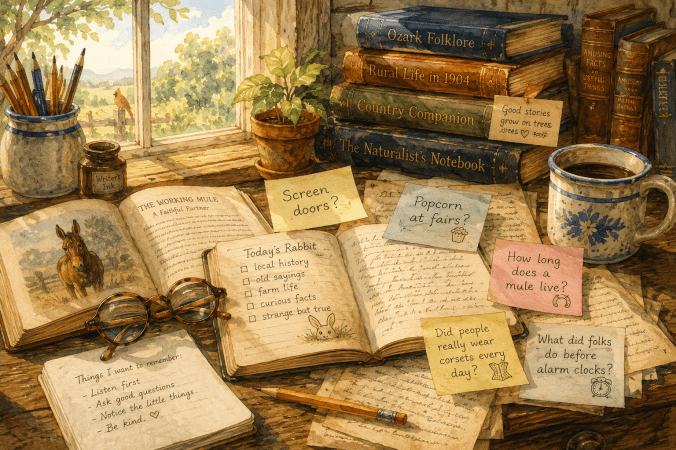
What they may not realize is that magazine week also tends to produce questions such as:
- Was cotton candy available in 1904 outside the World’s Fair? (It wasn’t, and was known as “Fairy Floss” at the time.)
- Did local fairs sell popcorn in 1904?
- How did families keep ice through the summer before electric refrigerators?
- Were screen doors common in rural Missouri?
- How long could a working field mule remain useful on a farm?
- Could a mule out-smell a Bloodhound? Who had better hearing?
- What brand of coffee might have been found in a country kitchen in 1904?
- Would a general store have sold bananas?
- Were older animal and vegetable-based lamp oils still in use or kerosene?
- Were plowshares still made from cast iron or newer steel in 1904?
These are not questions that came up very often during my school years. Even with a minor in American History. Yet somehow they have become a regular part of my writing work now.
- Myrtle Mae’s blackberry ice cream sent me down one trail.
- Percy Puddlesniff and Elmer the Mule sent me down another.
- Lillian Harper’s Strawberry Festival in June created a whole collection of questions of its own.
- Felicity had me learning about the Woman’s Anchorage at the 1904 St. Louis World’s Fair.
- Henry’s article in the June issue had me researching whether Coca-Cola was generally available in the Honey Hill Country region in 1904 yet? If not, which beverages were available other than sweet tea and lemonade?
And these are merely a few. What sounds like a simple story idea often turns out to be attached to a surprising amount of research.
A reader may see a sentence about homemade ice cream and think nothing of it. Meanwhile, I have spent part of an afternoon learning how families stored ice through the summer months, how they came by it in the first place, the proper ratio of rock salt to ice that was needed for hand-cranked ice cream freezers, and whether Blackberry ice cream would have been a realistic July treat in 1904. Or would it have been Strawberry? Or possibly Peach? Wild Plum? Would they make a Black Walnut ice cream, perhaps?
The challenge isn’t writing about 1904.
The challenge is in making sure 1904 agrees with what I have written.
The funny thing is that I actually enjoy this part. A lot. Most evenings I find myself knowing at least a little more than I did in the morning, and frequently a great deal more, as every article becomes a little treasure hunt. And that’s a good thing.
Taking the responsibility for accuracy very seriously, one question leads to another, and before long I find myself reading about harvesting river ice in January, sawdust-insulated ice houses, mule lifespans, mail-order catalogs, rural stores, turn-of-the-century agricultural equipment and tools, sandwiches of the period, or the history of screen doors.
Before I know it, an entire afternoon has wandered off somewhere into the countryside
Not that I am complaining. Because one of the great pleasures of writing about Honey Hill Country is discovering things I never knew before. Every answer helps make the world feel a little more real. For both the reader and me. And hopefully, that will also serve to help make the coming books even richer with an already built world of characters, places, and information to draw from.
And every answer seems to create three more questions.
The July issue of Hearth & Holler will arrive soon carrying the answers to at least a few of this month’s mysteries.
As for August, I suspect the next collection of questions is already waiting somewhere to be discovered.
Perhaps Myrtle Mae will send me searching for another forgotten kitchen tradition.
Or Percy will decide he needs to compare the eyesight of a barn owl to that of a hound dog.
Perhaps Willow Meadows will wander down a country lane and have me researching a plant, tree, rock formation, wild bush, or something else entirely. Something I have never once considered before. Wildflowers and field grasses? And what was the most-planted field crop in southeastern, central, kind-of-in-the-middle-but-no-so-much Missouri in 1904?
I never know how deep the next rabbit hole may be. I only know there will almost certainly be one, with a treasure trove of information at the bottom of it.
And if experience is any guide, it will begin with a simple question that I never thought I would need to know the answer to.
It most often begins with — “I wonder if . . . . ”
One August question is already whispering in my ear — “I wonder if a watermelon wagon would have used steel-rimmed wheels in 1904?”
“I wonder if . . . . ”
Till next time then —
Jim (and Red!)

P.S. from Little Red Bear
I asked Jim why he spends so much time researching.
He said he simply wants Honey Hill Country to feel real for readers.
That seems fair, I suppose.
Although I could have saved him a considerable amount of time by simply telling him that mules are large, ice cream is delicious, and screen doors are useful. And that when I need information, I usually just ask the first person I meet.
This works reasonably well unless the first person happens to be Hickory Pinenut.
— Red 🐾
Images have been created for this piece with the assistance of AI . . . lovingly prepared and styled for Honey Hill Country and the world of Little Red Bear.



Enjoyed this, James. Researching can be a lot of fun.
Rosie Russell Books By Rose “Engaging Young Readers One Book at a Time”
Find me on the below sites:
Rosie Russell
Website/Blog | Facebook | Twitter | Goodreads | Instagram | Pinterest
Website/blog – https://booksbyrose.com/ Facebook https://www.facebook.com/BooksbyRose/ Twitter https://twitter.com/RosieRrbjj Goodreads https://bit.ly/36IiflU
Instagram https://www.instagram.com/booksbyrose4u11/
Pinterest https://www.pinterest.com/rose1628/_save https://www.pinterest.com/rose1628/_saved/
LikeLike
Thanks so much, Rosie! Researching truly is a lot of fun for me. Learning something new every day. 🤠 🐻 ❤️
LikeLike